You spent thirty years building the account. Almost nobody sits down and tells you how to turn it into a paycheck. This takes about two minutes and shows you which of the four retirement income risks you're still exposed to.
No cost. No obligation. Nothing gets sold to you inside the quiz.
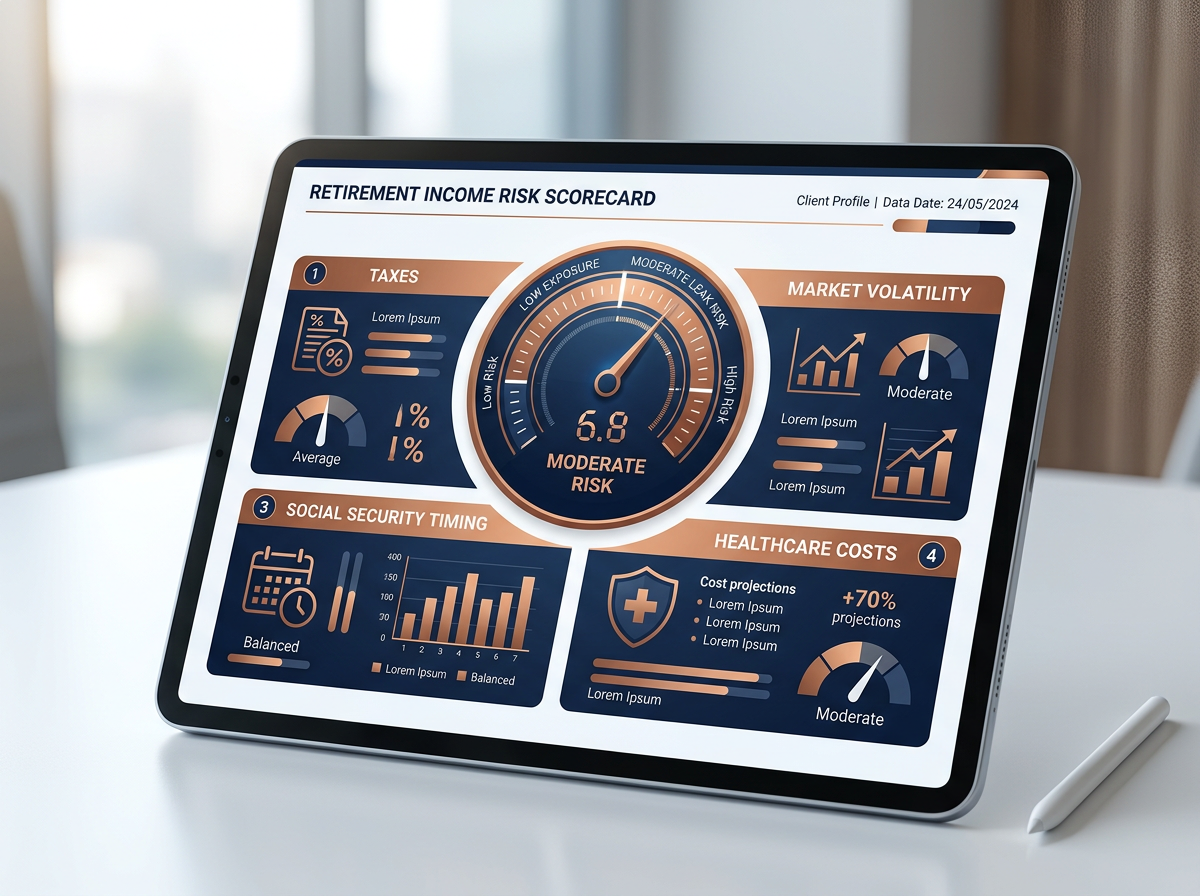
This is a free educational assessment built for people nearing or already in retirement. It's designed to surface the leaks that quietly work against a solid-looking plan — taxes, Social Security timing, market volatility, Medicare surcharges, and healthcare costs. No financial calculations. No spreadsheets. Just eight short questions and a clear answer.
See Where I StandA plain-English explanation
Most retirement plans are built for the twenty years before retirement, not the thirty years after.
Here's what I mean.
Say you've got $500,000 and it's been managed well. If your advisor charges 1%, that's $5,000 a year — and it comes out whether the market went up or down. That's the part most people understand.
Here's the part they usually haven't thought through. The market takes a 20% turn. That $500,000 is now just over $400,000. And you still need your monthly income, because the mortgage, the utilities, and the insurance premium don't care what the S&P did last year.
So you take the same withdrawal out of a smaller account. Now there's less money left to grow when the market does turn around.
If you get two or three of those years in a row — and we did, in 2000, 2001, and 2002 — the account goes down a lot faster than anyone planned for.
That's the whole problem in one paragraph.
The way around it isn't complicated. You separate out the expenses that show up every single month no matter what — the ones that are the same whether you're on vacation or sitting on your couch. Then you cover those with income that isn't tied to the market at all. The rest of the portfolio can stay in the market and do what it does.
If that sounds unfamiliar, it shouldn't. Social Security works that way. A pension works that way. An income that lasts as long as you do — that's all we're talking about.
Retirement risk rarely comes from one obvious mistake. It comes from a handful of overlooked decisions that compound over the years — and by the time they're visible, the options for fixing them have narrowed.
Taking income in the wrong order — or from the wrong accounts — can drain savings years earlier than planned, especially during market downturns.
Healthcare costs and Medicare surcharges often catch retirees off guard, showing up as an unplanned monthly hit right when income is fixed.
Poor timing on Social Security claiming or portfolio drawdown can create consequences that are permanent — and expensive — once locked in.
These aren't abstract risks. Each one has a real, measurable cost that grows the longer it goes unaddressed — and each is exactly what this diagnostic is built to detect.
Social Security Timing
Claiming at the wrong time is one of the most common — and costly — mistakes in retirement, with the loss compounding over a lifetime of payments.
Tax Drag
Inefficient withdrawal order and unmanaged tax exposure can materially shorten how long a portfolio lasts, even with strong investment returns.
Healthcare & SurchargesLifetime healthcare costs run large, and Medicare surcharge surprises are far more common than most retirees expect.
The diagnostic uses ten straightforward questions, calibrated to detect the core retirement leak variables sitting inside your current plan. It's educational, private, and easy to complete — before your options start to narrow.
Your Leak Score
A personalized number that reflects your overall exposure
Top Threat Analysis
A clear look at the biggest financial risk in your plan today
Actionable Steps
A clear starting point for addressing what's uncovered
Fast Delivery
Results delivered quickly and explained in plain English
One visitor was planning to claim Social Security earlier than intended. Taking the diagnostic surfaced the timing risk in time to reconsider, before the decision became permanent.
Another household discovered their IRA withdrawal order was creating unnecessary tax drag — a fix that was simple once it was identified, but easy to miss on their own.
Beyond the financial clarity, the most common response is simple peace of mind — knowing where you stand instead of hoping the plan holds up.
Safe Money Steps was built by Ken Keplinger, who has worked with retirees and pre-retirees across Florida and the United States since 1989. His focus has always been wealth preservation and income planning — helping people move from simply saving money to knowing their income is protected. This diagnostic reflects that same educational mission: to help you see clearly, so you can retire with more stability and less guesswork.
Is this useful if I don't want to share financial details?
Yes. The quiz never asks for account numbers or balances — only how your plan is structured.
Will this turn into a sales pitch after I start?
No. It's completely free, with no obligation, and nothing is sold to you inside the quiz.
Can eight questions actually tell me anything meaningful?
Yes. The questions are calibrated specifically to detect the four core retirement income risk variables — most people finish in under 3 minutes with no calculations or documents needed.
Does this apply to me if I already have an advisor or a sizable account?
Yes. A solid account balance and a solid income plan are two different things — this diagnostic looks specifically at the income side, regardless of who manages your investments.
Is my personal information protected?
Yes. Your information is used only to generate and deliver your scorecard, and it is never sold.
Small, overlooked planning errors can quietly reduce your freedom in retirement — and some decisions become harder to change once they're locked in. The diagnostic is the simplest next step toward clearer income planning. It takes about two minutes.